



Spring officially started this past week, and the garden is beginning to show signs of life beyond just the kale that grew all through the winter. Crazy enough though, we did see the tiniest bit of snow on Friday. It didn’t stick, but low temperatures were down in the 30s yet again. We may not be buried in snow again and again like the northeast has been this winter, but we’ve had more than our fair share.
Thanks to the unseasonably cold weather, I’ve gotten a slow start in the garden this year. I’ve been afraid to start anything that isn’t really hardy because a cold snap could kill them off.
Another change to the garden this year is an adjustment on how much money I spend. In the past, I’ve gone overboard with seed catalogue purchases and have always ended up with way more seeds than I could ever plant in one season.
This year, I will be buying very few new seeds and starts, even if it means less variety. I’m also planting some older seeds (packed for 2014 and 2015) that may not germinate as well as new ones, but since I did buy them, I will do my very best to use them up. In order to combat lower sprouting rates, I’m planting more of them in an area in hopes I’ll still have plenty grow.
Spring planting to date:
- Black Seeded Simpson Lettuce
- Little Snowpea Purple
- Walla Walla Sweet Onions
- Northwest Wildflower Mix
- Yukon Gold Potatoes
To plant this month:
- Nantes Carrots
- Evergreen Bunching (Green) Onions
- Sugar Snap Peas
Perennials:
A big part of my garden these days is made up of perennial plants that come back every spring with very little effort on my part. We’ve had blueberry bushes for a while, but four summers ago when I was pregnant we specifically expanded our perennials, knowing that with a baby we wouldn’t have as much time to work in the garden for at least a few years.


Even now that we have more time again, the set up we did years ago is paying off considerably well. We have loads of blueberries and raspberries in the summer, and all that we need to do is a little bit of pruning, fertilizing, and water (and the blueberries need very little water now that they have their roots set). This early in the year, the berry bushes are starting to sprout buds, but we are able to just ignore them and let them do their thing.
If you ever want a low maintenance edible garden, at least in the northwest, I would highly recommend planting berries. Blueberries have to be purchased by the plant, but if you know anyone with raspberries, they should be more than happy to dig up a few starts for you to have, as they grow and spread like crazy (we have to mow down the shoots that sprout up in the lawn outside of the raised bed).
The garlic we first grew a number of years ago has turned into a delicious weed as well. We’ve attempted to dig it all up, but it keeps coming back. We do eat a ton of garlic, so it’s not all bad, but we absolutely will have to pull it all after this summer in order to give the bed a rest for a couple years.
Like most vegetables, garlic is prone to a variety of diseases if left in the same spot year after year, so it’s best to move it around (the diseases hang around in the soil but generally die out once the plant is removed). We’ve been lucky up until now, but I don’t want to push it to the point where we have to start fighting a problem.
The garlic bulbils I planted in October (in an entirely different spot in the garden) have started to sprout as well, but they are very tiny. I’m interested to see how large they can grow by garlic harvest time in late summer, but perhaps it will take a second year before they really grow large enough to harvest.

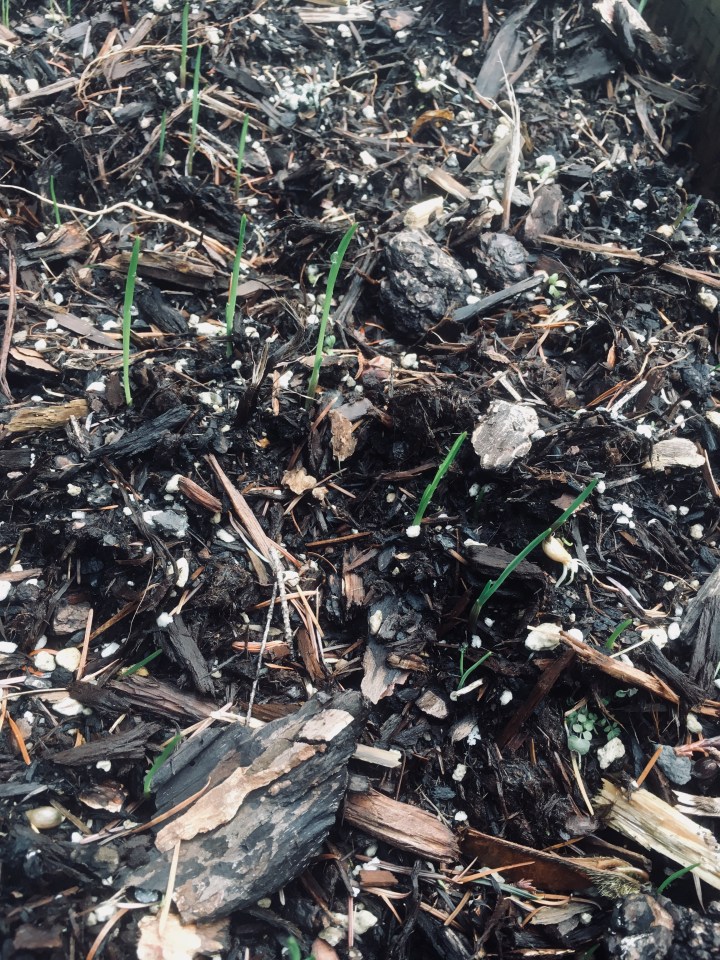
The rhubarb has also started to poke through the soil, but there has been no sign of asparagus as of yet. Since we have now had icy mornings past Seattle’s typical frost date for the year, I’m not surprised that we’re seeing a late start. My only hope is that the extra cold weather doesn’t kill off any of the early starts.
Thankfully, the kale and garlic is pretty cold hardy, so both haven’t been impacted by the unseasonably cold weather. Better yet, since we still have kale growing and have recently harvested some early garlic for ramen, I now officially have a year round garden for the first time ever. I’ve previously had carrots growing into December, but January and February are notoriously barren months.
I plan someday to set up cold frames so more plants can make it through the winter, but for now, I’m pretty enamored with kale for its low maintenance, cold hardy self.

For the first time, I plan to track my garden purchases closely to determine how much money I actually spend in the garden during the year. I realize this won’t cover the water use in the driest months, but we do have a rain barrel and I mulch pretty heavily to reduce the amount of irrigation needed. Watering at the very beginning or end of the day also reduces water use by quite a bit, because a lot of midday watering is lost to evaporation.
Expenses to date: $18.95 (including tax)
- Seed potatoes $5.99
- Onion starts $3.33
- Wildflower seeds $3.99
- Carrot seeds $1.14 (half off)
- Green onion seeds $1.89
- Sugar snap peas $0.89 (half off)
I’m very impressed with myself that I have been able to control my seed buying impulses, because at this point in the year I would generally have spent A LOT more than twenty dollars. I’ve also made sure to grab the free bags of coffee grounds from Starbucks for fertilizer, and I also had a few bags of regular fertilizer left over from last year. Once the raised beds are set up, gardening doesn’t have to be expensive (as long as you can resist the siren call of the heirloom seed catalogues).
If you’re interested in my previous garden updates, you can read about them here and here.
Are you growing a garden this year? What’s your favorite thing to grow? Mine would have to be our berry bushes for their simplicity.